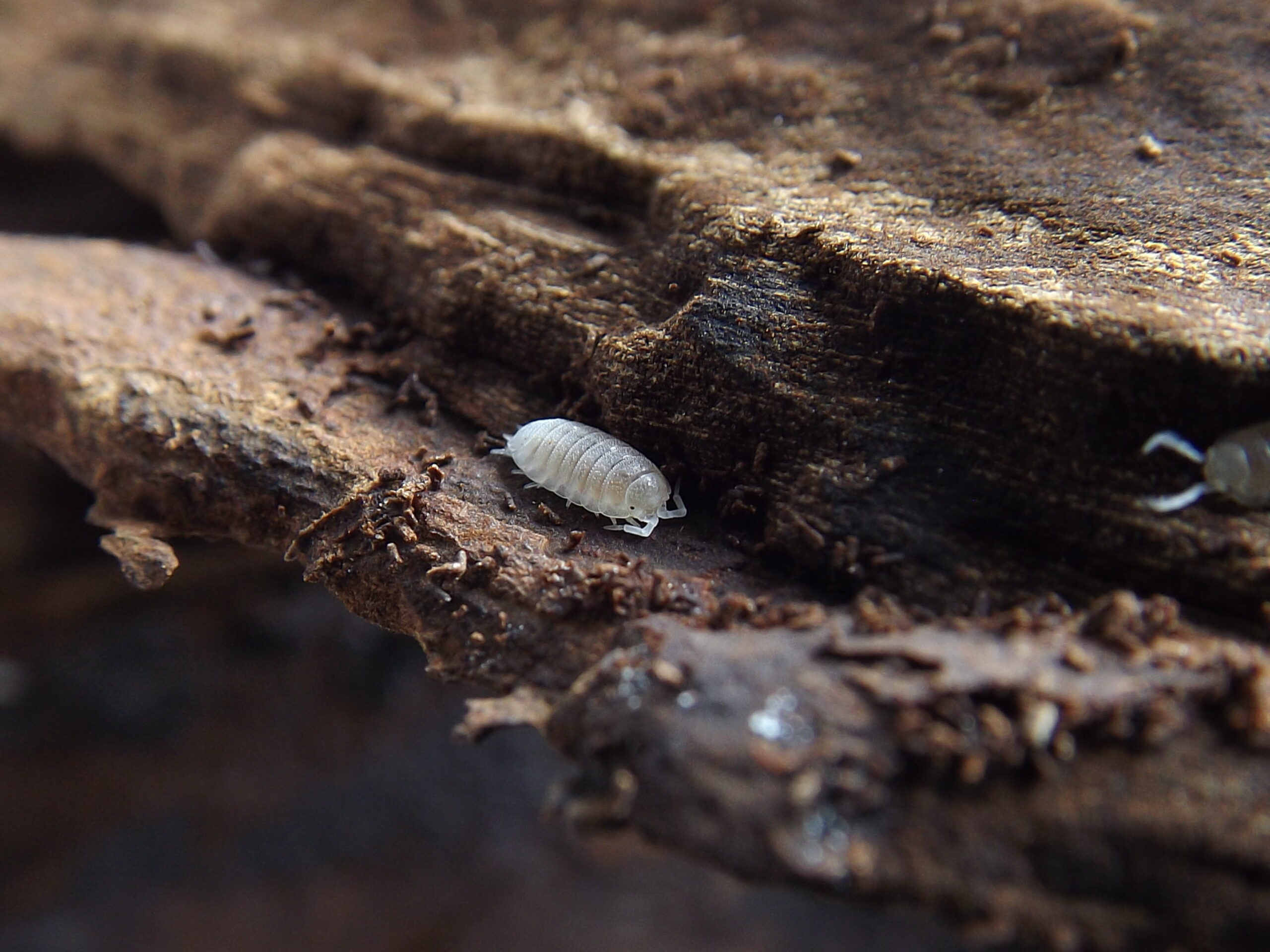
Trichorhina tomentosa
Meet the white dwarf isopod: a tiny terrestrial crustacean with an outsized role in the leaf-litter community. This is a planned part of KA’AETÉ’s future bioactive ecosystem, not an animal already living in a finished habitat.
A forest-floor recycler
Trichorhina tomentosa is a described terrestrial isopod. Among moist pieces of wood, leaf fragments and sheltered litter, small isopods can fragment organic material and help keep it available to fungi and other decomposers. They are one part of a wider community: bacteria and fungi do much of the chemical decomposition.
Because these animals are so small, they occupy crevices that larger isopods may rarely reach. Their ecological importance is easy to overlook when all attention goes to colourful show animals.
What KA’AETÉ must provide
Our planned, connected forest-floor habitats need continuously moist refuges, organic litter, textured wood and safe routes between microzones. Ventilation and water levels must be controlled without drying all resting spaces. Suitability, legal and captive-bred provenance, and interactions with other decomposers need confirmation before animals are acquired.
Project status, October 2026: Selected in the current isopod direction; not introduced. The cabinet’s physical build began on 16 October 2026 with the first compact-HPL base panel. Neither the photograph nor an artistic impression is evidence of an inhabited KA’AETÉ habitat.
Why this matters
KA’AETÉ is designed around connections rather than a collection of display animals. Fungal growth, bacteria, litter fragments and small crustaceans exchange material across the forest floor. Only long-term observation can show how that network develops in the actual build.